
This is part one of a two part series about select songs from the “Sirens” episode. You can read part one here.
“Bloom’s, the novel’s, and, apparently, Joyce’s answer to a rancid discourse of Irish nationalism appears to be nothing more than gas, flatulence induced by an Irish diet too rich in that unctuous, “grosser” nationalist rhetoric.” – Toby Loeffler
Ulysses’ eleventh episode, “Sirens,” closes with its second major musical set piece – “base barreltone” Ben Dollard’s rendition of the ballad, “The Croppy Boy.” Set during the 1798 Rebellion, “The Croppy Boy” tells the story of a young Irish rebel who stops in a Catholic church to give his confession to the priest before a big battle. In a cruel twist, the “priest” is revealed to be a British yeoman captain. The false priest arrests the poor croppy boy and sends him off to be executed. In addition to telling a fictional episode in the long history of Irish oppression by British colonizers, “The Croppy Boy” emphasizes a motif of betrayal that recurs throughout Ulysses as a whole.

Dollard’s performance comprises the second half of an idiosyncratic and impromptu double-billing with Simon Dedalus’ performance of the aria “M’Appari” from the opera Martha. Scholar Robert Adams remarked that this unlikely pairing demonstrates the “eclectic taste common to Dublin in [Joyce’s] youth,” in which a folk song like “The Croppy Boy” can “rub shoulders” with opera, arguing that this is evidence that the men in the Ormond were more accustomed to experiencing music through informal performances such as those dramatized in “Sirens” than through professional performances or recordings.
We know Simon Dedalus is based on James Joyce’s father John, but what about Ben Dollard? Vivien Igoe identifies him as John Joyce’s friend Christopher Dollard, “a well-known amateur bass singer in the 1880s,” aligning the real and fictional Dollards’ social circle and vocation. However, there are details of the fictional Dollard’s biography that don’t match the real Dollard, as narrated by Bloom:
“Ben Dollard’s voice. Base barreltone…. Big ships’ chandler’s business he did once. Remember: rosiny ropes, ships’ lanterns. Failed to the tune of ten thousand pounds. Now in the Iveagh home. Cubicle number so and so. Number one Bass did that for him.”
Ben Dollard, like so many other men in Bloom’s social circle, is absolutely drowning in debts and drink. Dollard was once a businessman, a ship’s chandler to be exact, selling supplies to ships (“rosiny ropes, ships’ lanterns). Due to his dependence on alcohol, Ben fell into crippling bankruptcy, “to the tune of ten thousand pounds.” These days he lives in a cubicle in the Iveagh home (or Iveagh Hostel), a shelter for impoverished and homeless men. Adams wrote that a Dublin-based ship’s chandler firm run by brothers George and William Merritt went bankrupt in the 1880s, leaving them in poverty later in life. While there is no record of the Merritts living in the Iveagh Hostel, John Joyce did occupy a cubicle there for a time. Given these details, I think it is possible that Ben Dollard is a composite of Christopher Dollard, the Merritt brothers, and John Joyce.
Dollard’s performance of “The Croppy Boy” resolves the twin themes of Love and War introduced by Dollard himself as he and Simon debated which songs to perform in the Ormond. Love was represented by Simon’s performance of “M’Appari,” a piece about a lost love. Dollard now takes the stage to represent War with a ballad about a betrayal during a lost war. Scholar Mark Osteen describes how this twin theme can be expanded to the consecutive episodes of “Sirens” and “Cyclops.” The enthralling sentimentality of “Sirens” is about to give way to ruthless brutality and chauvinism of “Cyclops,” but first a song!
Fr. Bob Cowley, a false priest of another sort, initially suggests that Ben sing “Qui Sdegno,” the Italian name of a song from Mozart’s Magic Flute (as was the style at the time). Cowley’s request is quickly shot down in favor of “The Croppy Boy.” Scholar Zack Bowen views this song selection as indicative of the Irish Nationalist mindset of the era. A wish for “Qui Sdegno,” a “song of peace and the banishment of strife,” is drowned out by calls for “The Croppy Boy,” a song that Bowen considers “inherently militant,” while combining the themes of betrayal, sentimentality, religion and war. Curiously, it’s Tom Kernan, the ambivalent Catholic convert, who requests “The Croppy Boy”:
“—No, Ben, Tom Kernan interfered. The Croppy Boy. Our native Doric.”
The reference to “our native Doric” is taken from a headline in “Aeolus.” Apparently those ethereal headlines of mysterious provenance have burrowed their way into Kernan’s subconscious. The passage in “Aeolus” over which this particular headline appears depicts Simon Dedalus and Ned Lambert mocking doughy Dan Dawson’s schmaltzy description of Ireland’s natural grandeur. The overlap of Dan Dawson and “The Croppy Boy” in Kernan’s request should catch our attention as readers. Their juxtaposition suggests the men’s love for “The Croppy Boy” and rejection of Dawson comes down to mere aesthetics, as they are both composed of the same empty patriotic pablum. Kernan, who has waxed poetic about the aesthetics of Protestant religion and aristocratic splendor in previous episodes, is an unlikely admirer of the tragic patriot Croppy. He offers a bit of insight in his private thoughts in “Wandering Rocks”:
“Fine dashing young nobleman. Good stock, of course. That ruffian, that sham squire, with his violet gloves gave him away. Course they were on the wrong side. They rose in dark and evil days. Fine poem that is: Ingram. They were gentlemen. Ben Dollard does sing that ballad touchingly. Masterly rendition.
At the siege of Ross did my father fall.”
When a ballad is trenchant, it’s trenchant, politics be damned. Kernan is happy to set aside his worldview for a chance to hear Dollard’s magnificent voice sing such a powerful ballad. Delightfully, Kernan does describe Dollard’s performance as a “trenchant rendition,” fulfilling Martin Cunningham’s prediction in “Hades.” During his passage in “Wandering Rocks,” we learn that Kernan is a bit of a history buff, recognizing key sites connected to the 1798 Rebellion and to famous rebels like Lord Edward Fitzgerald and Robert Emmet, so perhaps this is the source of his enjoyment for historic ballads, even those that celebrate the people “on the wrong side.” We’ll return to these ideas before the end of “Sirens.”
Just as with Simon’s rendition of “M’Appari,” we hear bits and pieces of “The Croppy Boy” interspersed with Bloom’s play-by-play commentary. Unlike with “M’Appari,” Bloom delivers fewer direct quotes and instead mainly paraphrases the story of the Croppy Boy, until Bloom is driven from the Ormond by his own farts. Overall, Bloom is quite averse to the patriotic message of “The Croppy Boy,” so just like with other displays of worship in Ulysses, Bloom isn’t taking anything very seriously:

“The priest’s at home. A false priest’s servant bade him welcome. Step in. The holy father. With bows a traitor servant. Curlycues of chords.
Ruin them. Wreck their lives. Then build them cubicles to end their days in. Hushaby. Lullaby. Die, dog. Little dog, die.”
Ben Dollard takes on the role of Siren, arresting his listeners’ attention with the Croppy Boy’s tale of woe and betrayal. Bloom is not particularly moved by the treacherous yeoman captain’s exploitation of the Croppy Boy’s faith. Instead, Bloom thinks about how Irish society in his own era betrays ordinary men like Ben Dollard and Simon Dedalus. Of course, the Blooms have been on the edge as well. Ordinary people are reduced to poverty and desperation by the economic malaise of the world around them. There is no meaningful social safety net to help them recover if, say, their business fails or a family member dies. There are cubicles waiting in the Iveagh Hostel where they can pass from the world without the more fortunate classes having to see them. This societal betrayal of desperate people is personal for Bloom, and more pressing than the tragedy of the fictional Croppy Boy. Bloom’s mistrust of religion resurfaces again. Back in “Lotus Eaters,” he viewed the Latin Mass as a tool to stupefy the communicants so they can “swallow” religion more easily. A similar thought rises once more as he imagines the Croppy Boy confessing:
“ in nomine Domini, in God’s name he knelt. He beat his hand upon his breast, confessing: mea culpa.”
The anaesthetic effect of Latin emerges from Ben’s song of faith and patriotism, a stupefying Lotus that now transforms into a deadly Siren. The Croppy Boy is not numbed by the Latin so much as lulled into a false sense of safety. The false priest creates a ruse that lures in the Croppy Boy, a scheming Siren rather than an indolent Lotus Eater. The Croppy Boy is operating blind, a detail that will tie him to the blind stripling later in this sequence. Similarly, Siren Ben Dollard is stupefying and lulling his audience in the Ormond with his sentimental, patriotic tale, designed to tug at his listeners’ heartstrings. All the listeners except Bloom, that is. Bloom is not wooed by sentiment, continuing to observe the Croppy’s story from a remove:
“The sighing voice of sorrow sang. His sins. Since Easter he had cursed three times. You bitch’s bast. And once at masstime he had gone to play. Once by the churchyard he had passed and for his mother’s rest he had not prayed. A boy. A croppy boy.”
Now the Croppy Boy confesses his sins to a false priest who can never absolve them. The Croppy Boy’s sins aren’t terribly grave by modern standards, nor are they particularly egregious to Bloom. First, the Croppy Boy apparently has a potty mouth, having cursed three times since Easter. Apparently he called someone a “bitch’s bastard.” This bit of color doesn’t appear in the lyrics of “The Croppy Boy,” but it does appear elsewhere in Ulysses, spoken by the blind stripling, who also has a potty mouth. In “Wandering Rocks,” the blind stripling is nearly knocked over by Cashel Boyle O’Connor Fitzmaurice Tisdall Farrell, to which he responds, “God’s curse on you… you bitch’s bastard!” This phrase echoes through “Sirens” in multiple places, first in response to the barmaids talking about the blind piano tuner, and then twice in reference to the Croppy Boy’s sins.
We’ve discussed previously how Simon’s song caused the Ormond’s patrons to merge in spirit and emotion, but Ben Dollard’s voice is so powerful that it begins to pull in people outside the room. The Croppy Boy and the blind stripling become one as the blind stripling’s staccato “Tap, Tap, Tap” joins the din of the episode. Bowen writes that the blind stripling and the Croppy Boy’s merger blends the motifs of “betrayal, false fatherhood, and blindness.” The blind stripling will physically enter the Ormond at the end of “Sirens” but he enters spiritually first, though lacking the Croppy Boy’s contrition for his foul language.

The Croppy Boy’s final sin, when “once by the churchyard he had passed and for his mother’s rest he had not prayed,” links him to Stephen Dedalus, who is tortured by the agenbite of inwit over his refusal to pray for his own mother. We’ve already seen Stephen experimenting with blindness in “Proteus,” closing his eyes while he walked on the strand to overcome the ineluctable modality of the visible. Stephen unwittingly mimicked the blind stripling on the strand, and now through parallel connections to the Croppy Boy, Stephen unwittingly melds with both the stripling and the Croppy Boy. This merger of Croppy-Stripling-Dedalus is completed in “Circe” when Bloom intervenes to save Stephen from Privates Compton and Carr in Nighttown. Bloom had previously extended a helping hand to the blind stripling in “Lestrygonians,” though it was met with ambivalence from the stripling. All three experience some degree of impaired sight: Stephen with his weak eyes and the Croppy Boy duped by an unseen foe. Like the Croppy Boy, Stephen is clobbered by British soldiers for something he said, though in his case it is due to being a smartass rather than fighting bravely for Ireland. Both Dedalus and the Croppy Boy are searching for a father of sorts, and both find a false father, in the Croppy’s case the yeoman captain and in Stephen’s case Simon. Unlike the Croppy Boy, Bloom offers a possibility of salvation to Stephen as a true father figure, and in turn, Stephen provides Bloom a surrogate son:
“All gone. All fallen. At the siege of Ross his father, at Gorey all his brothers fell. To Wexford, we are the boys of Wexford, he would. Last of his name and race.
I too. Last of my race. Milly young student. Well, my fault perhaps. No son. Rudy. Too late now. Or if not? If not? If still?
He bore no hate.
Hate. Love. Those are names. Rudy. Soon I am old.”

“The Boys of Wexford” reverberates from “Aeolus,” when the newsboys outside the Evening Telegraph office could be heard singing this folk song which, like “The Croppy Boy,” is a product of 1798. It’s connection with “Aeolus” subtly recalls the real-life betrayal of Lord Edward Fitzgerald during the 1798 Rebellion, orchestrated by Francis Higgins the Sham Squire. Higgins was the owner of the Freeman’s Journal when he betrayed Fitzgerald, connecting this history once more to “Aeolus.” Tom Kernan first inadvertently called attention to this connection through his musings on “The Croppy Boy” in “Wandering Rocks”: “That ruffian, that sham squire, with his violet gloves gave him away,” proving that these historical wounds are near the surface of Dubliners’ memories, even Tom Kernan’s. Kernan’s description of Higgins is preceded by his thoughts on Fitzgerald and Emmet, setting up another merger that will come to pass before the end of “Sirens.”
While Bloom is cynical about the sentimental, patriotic tone of “The Croppy Boy,” he’s not totally immune to its Sirenlike charms. The phrase “last of his name and race” hits close to home as he is still mourning the loss of his only son, Rudy. Empathetic Bloom, though he is not wooed by patriotism, is still able to inhabit the Croppy Boy’s pain. Bowen wrote that “inconsubstantially [Bloom] too becomes the croppy boy,” and notes that from this point forward Bloom begins anticipating the beats of the Croppy Boy’s story rather than merely commenting on what Ben has already sung.
Thoughts of Milly and the young student procreating to produce the reconciling grandchild heralded by Stephen’s Hamlet theory is cold comfort. Just as Stephen needs a father figure, Bloom needs a son to nurture. The hypostasis of Bloom and Stephen sharpens in “Sirens,” through the figure of Shakespeare. There is a line earlier in the episode where Bloom quotes Shakespeare to himself and an out-of-context line from Stephen’s Library dialectic briefly breaks through the music of the Ormond:
“In Gerard’s rosery of Fetter lane he walks, greyedauburn. One life is all. One body. Do. But do.”
A reconciliation is at hand, to be resolved through the father-son spiritual merger of Bloom and Stephen into Blephen and Stoom, though this will not reach its final form until their quality father-son chat in “Ithaca.” According to scholar Daniel Schwarz, once Stephen is healed by his encounter with Bloom, he can fully reclaim his life by birthing either a physical son or a creative son in the form of an epic for the Irish people. Stephen can represent Ireland as he knows it rather than falling back on the nostalgic tropes of “The Croppy Boy.” The resonance of the meetings echoes backwards and forwards through Bloomsday, and here we glimpse a ripple on that pond.
“Ireland comes now. My country above the king. She listens. Who fears to speak of nineteen four? Time to be shoving. Looked enough.
—Bless me, father, Dollard the croppy cried. Bless me and let me go.”

Bloom’s union with the Croppy Boy is short-lived, as he returns to his sarcastic commentary. In response to the phrases, “Ireland comes now. My country above the king,” Bloom silently responds, “Who fears to speak of nineteen four?” This is his own little ironic adaptation of the song “The Memory of the Dead,” which includes a lyric that asks, “Who fears to speak of Ninety-Eight?” in reference to the 1798 Rebellion. Bloom once more rejects the worship of country and history in favor of focusing on the problems of the present, altering 1798 to 1904 and highlighting the roomful of men more empathetic to a fictionalized past than their present reality. As an aside, this is the poem by Ingram that Tom Kernan alluded to in “Wandering Rocks” when he said, “Fine poem that is: Ingram.” Putting a compliment for the poem in the mouth of Kernan is likely an indicator that Joyce didn’t think much of Ingram’s verse. Bloom is beginning to get antsy; he’s had enough “Croppy Boy.”
“With hoarse rude fury the yeoman cursed, swelling in apoplectic bitch’s bastard. A good thought, boy, to come. One hour’s your time to live, your last.”
“The Croppy Boy” reaches its climax as the virtuous Croppy Boy, who so loves his country, is betrayed by the creeping yeoman exploiting the Boy’s dedication to his religious duties. The crowd in the Ormond is rapt and silent, tears in their eyes for the sacrifice of a martyr, Bloom thinks. Keeping with his character, Bloom can only think of the here and now and the suffering of Dubliners in 1904. In this moment, these thoughts manifest as concern for Mrs. Purefoy in the maternity hospital:
“Thrill now. Pity they feel. To wipe away a tear for martyrs that want to, dying to, die. For all things dying, for all things born. Poor Mrs Purefoy. Hope she’s over. ”
As Bloom contemplates his fellow bar patrons’ roil of emotions for the poor Croppy’s fate, an erotic dimension to their grief for the Croppy Boy reveals itself. This is a Siren’s song, after all, and part of the ineluctable allure is purely physical. Descriptions of the audience begin to linger on the physicality of the barmaids in particular, implying their attraction to the Croppy intermingled with their pity (“…heaving bosom’s wave…,” “Heartbeats: her breath: breath that is life. And all the tiny tiny fernfoils trembled of maidenhair.”) This imagery is accompanied by a scattered assortment of spent drinking paraphernalia, rich with double entendres (“Popped corks, splashes of beerfroth, stacks of empties.”) Lydia Douce is so gripped by the Croppy Boy’s ultimate betrayal that she pays particularly Freudian attention to a rather phallic beerpull as the song climaxes:
“On the smooth jutting beerpull laid Lydia hand, lightly, plumply, leave it to my hands. All lost in pity for croppy. Fro, to: to, fro: over the polished knob (she knows his eyes, my eyes, her eyes) her thumb and finger passed in pity: passed, reposed and, gently touching, then slid so smoothly, slowly down, a cool firm white enamel baton protruding through their sliding ring.”
A Siren song of patriotic martyrdom has the power to hijack listeners’ bodies as well as their emotions. They can’t help themselves but to steer into the rocks of unthinking nationalism. Ben’s performance of “The Croppy Boy” is innocent enough, but such emotions hold the potential to drive nations to war, conquest and ruin. Ultimately, any pleasure felt is masturbatory, though, as symbolized by Lydia’s handiwork. Bloom has previously fretted that tenors get all the women. Apparently, so do martyrs. Tangled in this whole sordid mess are Bloom’s memories of Molly and the crushing knowledge that she and Boylan will soon meet at 7 Eccles St., a much more real and immediate sexual betrayal for Bloom. Bloom shakes himself free of the tightening grip of the Sirens, acknowledging the sadness of the Croppy’s tragic betrayal (“Very sad thing.”) but as he is our Odysseus, he is capable of resisting Siren Ben Dollard’s song. It’s time to get out of Dodge. Bowen writes, “Bloom will not waste his time in pity over his own betrayal or the croppy boy.”
“At Geneva barrack that young man died. At Passage was his body laid. Dolor! O, he dolores! The voice of the mournful chanter called to dolorous prayer.”
The Croppy Boy is no more. Miss Douce’s malapropism “Idolores,” which had previously transformed into “shedolores” in response to Simon Dedalus’ song of lost love, now metamorphoses in “he dolores,” sorrow for the tragic doomed Croppy Boy. Bowen interprets this as the moment in which the theme of “love and betrayal” fully fuses with the theme of “war and betrayal.”
“Pray for him, prayed the bass of Dollard. You who hear in peace. Breathe a prayer, drop a tear, good men, good people. He was the croppy boy.
Scaring eavesdropping boots croppy bootsboy Bloom in the Ormond hallway heard the growls and roars of bravo, fat backslapping, their boots all treading, boots not the boots the boy. General chorus off for a swill to wash it down. Glad I avoided.”
Bloom, now in the safe harbor of the Ormond’s hallway, is about to make his final exit, evading the Sirens at last, while his peers have fully capitulated to the Sirens’ wiles. The celebrations of the crowd, now being consumed by the Sirens, sound rough and animalistic in Bloom’s ears, described as “growls” and “roars” and marked by the heaviness of boots. They will now cap off Ben’s performance with a round from issuing forth from Miss Douce’s phallic beerpull. Bloom is as succinct as ever: “Glad I avoided.” His alienation from the popular and social culture of his peers heading into the violence of “Cyclops” is quite stark. He is escaping while all the others around him drown in booze, the source of so many of their downfalls, and in the next episode, the source of their suspicions against Bloom’s motives and a pretext to antisemitic violence.
“And deepmoved all….”
The bar patrons rapturously applaud and congratulate Ben Dollard, their hearts so deeply moved by his incredible performance. Bloom is moved by another part of his anatomy, though. The line above is preceded by an ominous, “Rrr,” hinting at the fart building deep within Bloom’s bowels. Bloom makes a strategic exit.
“Up the quay went Lionelleopold, naughty Henry with letter for Mady, with sweets of sin with frillies for Raoul with met him pike hoses went Poldy on.”
Bloom-Odysseus has escaped the warlike Sirens and fully sailed free, or so he thinks. As he walks along the quay away from the Ormond, the narration identifies him as “Lionelleopold,” indicating that his heart is still gripped by the lovey Sirens rather than the war Sirens. This is reflected in his mental inventory of his collection of personal effects, including a reply to Martha and the copy of Sweets of Sin, an erotic novel that he intends to share with Molly once he’s home. The narration of the action holds its distance compared to the moments when we’re more clearly inside Bloom’s head, indicating that the omniscient narrator perceives the residual whiff of Sirensong clinging to Bloom, while he’s not ready to reckon with his own pain in the moment, knowing full well that Molly and Boylan are now together. Bloom chooses instead to judge the other men, drinking themselves into a stupor on pints poured by the barmaid-Sirens to dull their own private pain:
“Cowley, he stuns himself with it: kind of drunkenness. Better give way only half way the way of a man with a maid. Instance enthusiasts. All ears. Not lose a demisemiquaver. Eyes shut. Head nodding in time. Dotty. You daren’t budge. Thinking strictly prohibited. Always talking shop. Fiddlefaddle about notes.”
The effects of Simon’s song on Lionelleopold dissipate as he walks down the quay in the fresh air. By the time he encounters another Lionel, his various identities are starting to separate and float away from one another, allowing him to be Mr Leopold Bloom once more:
“Bloom viewed a gallant pictured hero in Lionel Marks’s window. Robert Emmet’s last words. Seven last words. ”
Bloom pauses in front of an antique shop, where he spots a picture of the real-life tragic Irish rebel Robert Emmet in the window. The picture is captioned with the final line of Emmet’s famous Speech from the Dock:
“When my country takes her place among the nations of the earth, then and not till then, let my epitaph be written.”

These are not Emmet’s last words, as Bloom says, but they are strongly connected with Emmet’s tragically failed rebellion and execution. The image of the fictional Croppy Boy is now replaced with the image of the real rebel Emmet, blending their romantic, patriotic images. Scholar F.L. Radford wrote that these patriotic heroes begin to merge in part because each is a flawed, heroic martyr for Ireland, as incomplete as a home without Plumtree’s Potted Meat. The right melange of Irish rebels was foreshadowed by Tom Kernan back in “Wandering Rocks”: Robert Emmet, Lord Edward Fitzgerald, and the Croppy Boy. Robert Emmet was a romantic figure, but in Radford’s view, not handsome or aristocratic enough. Emmet’s rebellion came too close on the heels of 1798 (Radford speculates the picture of Emmet in the window is left over from the centennial of Emmet’s death in 1903). He failed to gain support and was executed for his efforts to free his nation, not all that different from the humble Croppy Boy. On the other hand, Radford felt the betrayed Lord Edward Fitzgerald of 1798 was both handsome and aristocratic, but too Protestant (Emmet was also a Protestant). If we combine Emmet and Fitzgerald, and add a pinch of Croppy Boy’s Catholic piety, we can concoct the ideal martyr for Ireland. Unfortunately all these men are tied to the 18th century and either dead or fictional, so there is no hope of any of them delivering the Ireland of the 20th century. Worshiping them can only lead to political stagnation.
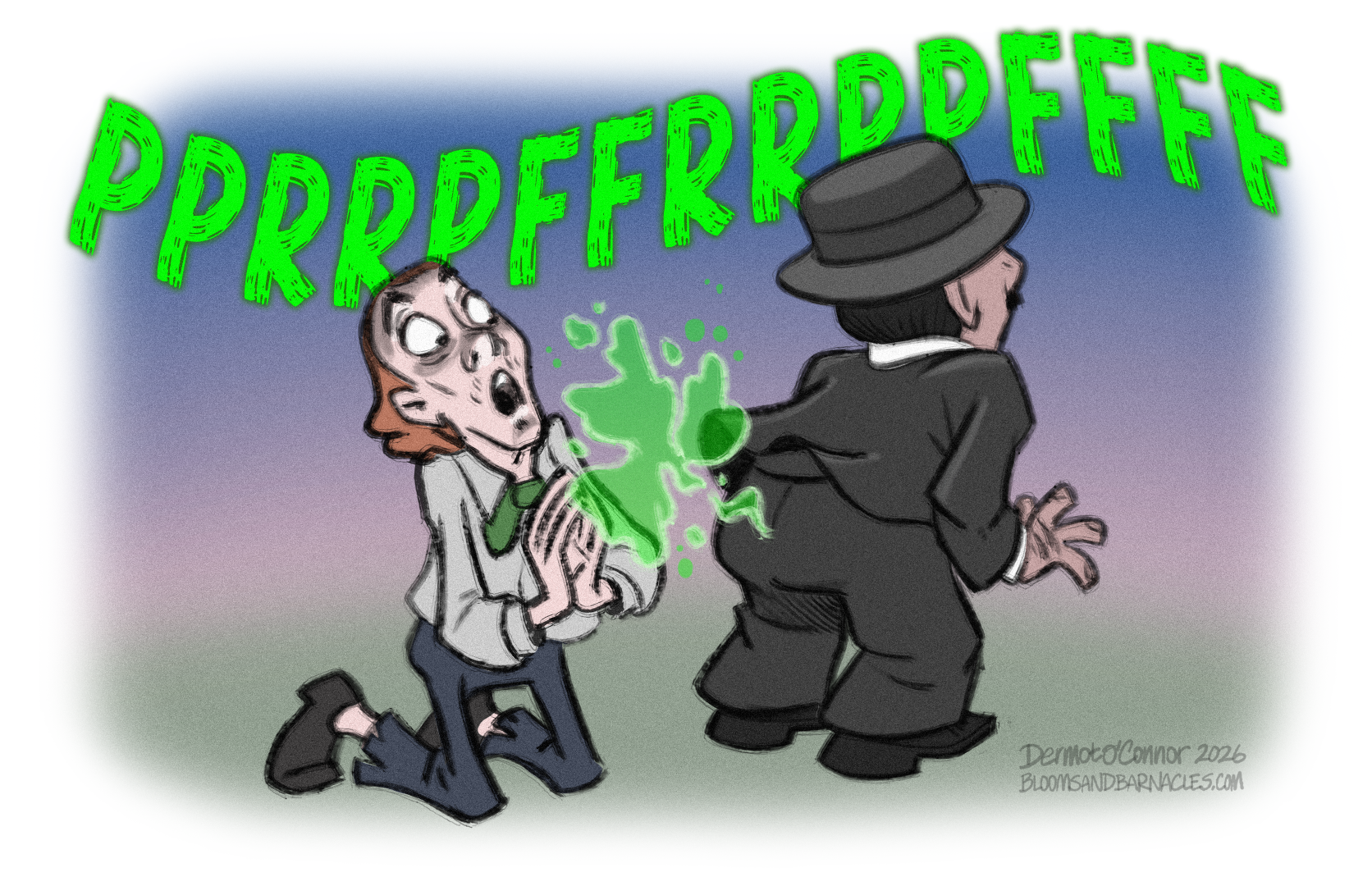
Any chance of Bloom uniting with this patriotic trinity is completely undercut by his prolonged fart. The soaring rhetoric of Emmet instead intermingles with a loud, comic fart, timed to be covered up by the sound of a passing tram. Bloom managed to hold the fart out of some sense of propriety while the whore of the lane passed, and then deliver it in all its glory while making eye contact with Ireland’s fallen martyr Emmet. Just in case Bloom’s contempt for “The Croppy Boy” was too subtle for you, Joyce broadly drives the point home here. His opinion of worshipful Irish nationalism is reduced to a juicy fart sound effect, reverberating throughout the novel in various little fart jokes drifting about here and there. Despite all of Joyce’s irony and snark flung at Irish nationalism, scholar Toby Loeffler writes that those who love Ireland may actually be having the last laugh, as Joyce’s work “contributes to the very project that it ostensibly negates… assembling a vision of Ireland’s national community.”
Further Reading
- Adams, R. M. (1962). Surface and symbol: The consistency of James Joyce’s Ulysses. New York: Oxford University Press.
- Bowen, Z. (1974). Musical allusions in the works of James Joyce: Early poetry through Ulysses. Albany:State University of New York Press. Retrieved from https://tinyurl.com/y9erlwtw
- Cope, J. (1974). Sirens. In C. Hart & D. Hayman (eds.), James Joyce’s Ulysses: Critical essays (217-242). Berkeley: University of California Press. Retrieved from https://tinyurl.com/wu2y7mg
- Ellmann, R. (1972). Ulysses on the Liffey. Oxford University Press. Retrieved from https://archive.org/stream/in.ernet.dli.2015.65767/2015.65767.Ulysses-On-The-Liffey_djvu.txt
- French, M. (1978). The Voices of the Sirens in Joyce’s “Ulysses.” The Journal of Narrative Technique, 8(1), 1–10. http://www.jstor.org/stable/30225626
- Gifford, D., & Seidman, R. J. (1988). Ulysses annotated: Notes for James Joyce’s Ulysses. Berkeley: University of California Press. Retrieved from https://tinyurl.com/vy6j4tk
- Herring, P. (1974). Lotuseaters. In C. Hart & D. Hayman (eds.), James Joyce’s Ulysses: Critical essays (71-90). Berkeley: University of California Press. Retrieved from https://tinyurl.com/yy2gpfhs
- Igoe, V. (2016). The real people of Joyce’s Ulysses: A biographical guide. University College Dublin Press.
- Loeffler, T. H. (2009). “Erin go bragh”: “Banal Nationalism” and the Joycean Performance of Irish Nationhood. Journal of Narrative Theory, 39(1), 29–56. http://www.jstor.org/stable/30224663
- Radford, F. L. (1978). King, Pope, and Hero-Martyr: “Ulysses” and the Nightmare of Irish History. James Joyce Quarterly, 15(4), 275–323. http://www.jstor.org/stable/25476147