
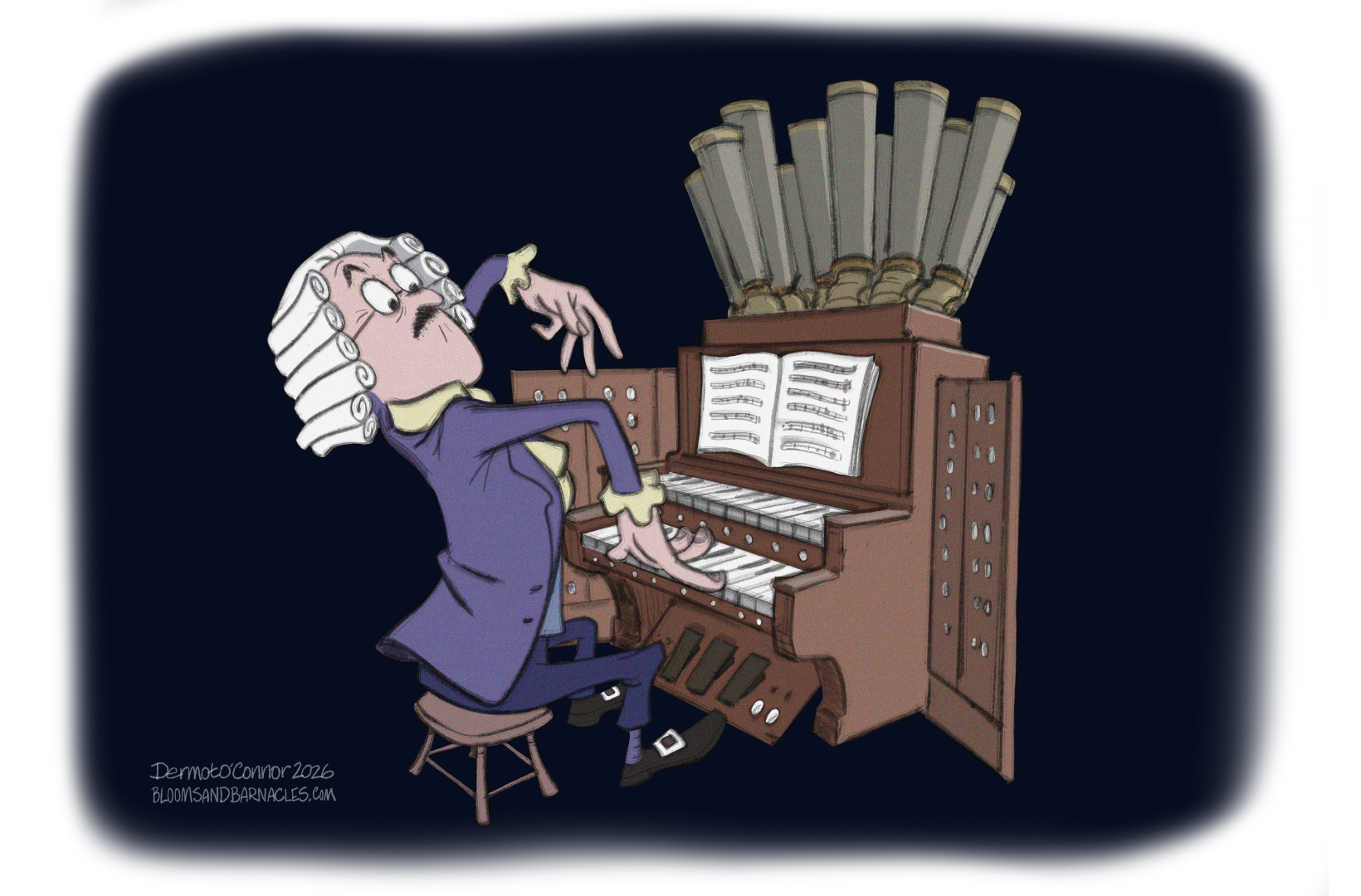
“Since exploring the resources and artifices of music and employing them in this chapter, I haven’t cared for music any more. I, the great friend of music, can no longer listen to it. I see through all the tricks and can’t enjoy it any more.” – James Joyce, 1919
Joyce’s ambition for “Sirens,” the eleventh episode of Ulysses, was to render the complexities of a piece of music into narrative prose. It’s not enough to simply write an episode filled with references to famous pieces of music or even an episode that adhered to the rhythms of poetry or lyrics, though. Rather, Joyce wanted his prose to function as musical notes, calling and responding to one another as the music builds, harmonizing vertically as well as progressing horizontally, capturing the simultaneity of musical notes in words, forming chords of language rather than notes. Author Frank Budgen extolled Joyce’s artistry:
“The beauty of ‘The Sirens’ episode lies in this: that Joyce has mimicked all the musician’s mannerisms and rhythmical devices with so much fantastical humour, at the same time carrying his own narrative a most important step forward. It was a field day for the virtuoso in Joyce.”
However, not all commentators are as effusive as Budgen in their analysis of “Sirens.” While still composing “Sirens,” Joyce had to hard sell both Ezra Pound and Harriet Shaw Weaver on his vision for the episode. Joyce won out in the end but has left scholars scratching their heads up to the present day. Some, like scholar Karen Lawrence, feel that “the drama of the writing usurps the dramatic action” of “Sirens.” Scholar Daniel Schwarz felt it didn’t distract too much, but nonetheless concluded, “Joyce does not fully succeed in transforming words into sounds or in creating a musical texture of experience that supplements the representational qualities of music.” Before drawing our own conclusions, we must examine how Joyce went about accomplishing this herculean artistic feat.
In the Gilbert Schema, the technic of “Sirens” is listed as “fuga per canonem.” This refers to a style of song called a canon or a round. The fuga per canonem has its roots in medieval ecclesiastical music, but you likely encountered this type of song in elementary school. In a round, the first singer begins with the first bar, and then the others join one by one, all singing the same bar shifted slightly in time. Sung together, the staggered voices produce chords. Think “Row, Row, Row Your Boat” or “Frère Jacques.” Stuart Gilbert explained in his 1930 reading guide, Ulysses: A Study, how the fuga per canonem forces us to listen to all the parts simultaneously and to hear the notes “vertically as well as horizontally” in order to fully understand the music.
To appreciate what Joyce is getting at with the structure of “Sirens,” we must return to our old friends “nebeneinander” and “nacheinander” that we met on the strand in “Proteus.” Much like Stephen wandering along Sandymount Strand, music embodies both time and space, existing simultaneously in time (nebeneinander) as well as simultaneously in space (nacheinander), while prose doesn’t normally exist simultaneously with itself in the same way. Budgen says, “Poet and musician only part company when the musician writes his notes übereinander and sends them forth on the airs in clusters and swarms.” To listen to the “notes” in isolation in “Sirens” puts the reader at risk of missing “the curious emotive quality of Joyce’s prose,” so says Gilbert. And how exactly do you represent prose vertically? The answer is fuga per canonem. Prior to the publication of Ulysses, Joyce used the term “fuga per canonem” in a 1919 letter to Weaver to defend his vision for “Sirens” as mentioned above, insisting to her that the episode contained “all the eight regular parts of the fuga per canonem” in its structure. This raises more questions than it answers. First of all, the fuga per canonem doesn’t have eight regular parts. Also, does “Sirens” really cycle endlessly like a round?
Gilbert explained in great detail how “Sirens” is structured like a fugue. A fugue is a far more complex work of music than the fuga per canonem (think Bach’s “Well-Tempered Clavier” vs. “Row, Row, Row Your Boat”). Though individual fugues may vary, typically a fugue introduces a musical statement, called a Subject, which is then transformed and developed through an Answer and Counter-Subject, intertwined in an intricate contrapuntal chord structure. Between these main statements are Episodes that lead the listener in yet other directions as the piece develops. Gilbert’s analysis fits “Sirens” into this structure, describing the Sirens’ song as the Subject, Bloom’s entry and monologue as the Answer, and Boylan as the Counter-Subject. The Episodes are Simon Dedalus’ and Ben Dollard’s performances.
This introduces a new problem: “fugue” and “fuga per canonem” are not interchangeable terms. Why does Gilbert list the technic as “fuga per canonem” and then analyze fugues for two pages? Gilbert has said that he was reproducing Joyce’s explanation word-for-word in this passage, so we can infer that Gilbert was not off-roading it here. Did Joyce mean “fugue” when he said “fuga per canonem?” Why wouldn’t this be amended before Gilbert’s guide went to press? In Richard Ellmann’s biography of Joyce, the biographer shares an anecdote from a friend of Joyce’s named Georges Borach. He recalls a 1919 conversation in which Joyce explained how “Sirens” was structured as “a fugue with all musical notations.” This leads us back to the same question: if Joyce meant “fugue,” where does “fuga per canonem” come into the mix? Why did he tip off Borach but not the author of the guide to his novel? Also, “fuga per canonem” was committed to writing in that Weaver letter around the same time Borach recounted Joyce saying “fugue.” Borach was rehashing this conversation with Ellmann many years after the fact, so could Borach be substituting a much more common term (fugue) in his memory for the relatively obscure term, “fuga per canonem?”
This discrepancy has truly kept the scholars guessing for the ensuing one hundred years and change. Arguments have been made that “Sirens” is built around a strict canonical structure, while others state that “Sirens” is built around a Bach fugue. Scholar Zach Bowen argued that “Sirens” can’t possibly be a fugue because it has an overture, and fugues don’t have overtures. Scholar Nadya Zimmerman, on the other hand, argued that “Sirens” is simply an amalgamation of “fuga per canonem” and “fugue” and that Joyce wasn’t applying the terminology particularly rigidly. By the turn of the millennium, some exasperated scholars had concluded that the whole fuga per canonem business must be a hoax. Despite the discourse, no definitive conclusion was reached.
Scholar Michelle Witen explained that many scholars simply accepted the label “fuga per canonem” while also applying some, but not all, aspects of a fugue to their interpretation of “Sirens.” She warned, “Those who engage with the actual form of the fugue tend to descend into extremism.” Here be dragons. In particular, the mystery of the “eight regular parts” teased and tormented these scholars, like Stephen Dedalus trying to find a third rhyme for “mouth” and “south.” Neither the fuga per canonem nor the fugue has eight prescribed parts. Also, what does “parts” even mean? Does it mean eight voices? Eight sections of a musical piece? Eight themes explored in the “Sirens” episode through this musical structure?
Zimmerman argued that the “eight parts” were eight “distinct, major voices,” in other words, the main cast of characters in the episode singing in rich, complex harmonies together. She felt that the characters’ overlapping actions were the basis of the “chord structure” of the episode, not totally dissimilar from the simultaneity employed in the preceding “Wandering Rocks” episode. Zimmerman uses the opening vignettes of the episode as an example of this technique, with the barmaids gossiping in the Ormond as the Subject and Bloom’s thoughts as he passes Moulang’s pipes as the Answer, demonstrating two simultaneous actions in counterpoint to one another.
In a paper entitled “Bronze by Goldenhair: Music as Language in Chamber Music and ‘Sirens,’” scholar Patrick Milian, lays out a detailed chart of “Sirens” to demonstrate how these eight characters’ voices align in a fugal structure throughout the episode. Milian additionally argues that the interwoven textual and musical structure in “Sirens” is a development on similar experiments with music and language begun in Joyce’s early poetry collection, Chamber Music. Joyce seems to have agonized over the intensity of his attempt, telling his friend Borach, “Since exploring the resources and artifices of music and employing them in this chapter, I haven’t cared for music any more. I, the great friend of music, can no longer listen to it. I see through all the tricks and can’t enjoy it any more.” This exhaustion can be felt in Bloom’s observation in “Sirens”:
“Numbers it is. All music when you come to think. Two multiplied by two divided by half is twice one. Vibrations: chords those are. One plus two plus six is seven. Do anything you like with figures juggling. Always find out this equal to that. Symmetry under a cemetery wall…. Musemathematics. And you think you’re listening to the etherial. But suppose you said it like: Martha, seven times nine minus x is thirtyfive thousand. Fall quite flat. It’s on account of the sounds it is.”
The question of whether or not Joyce was successful is, in my opinion, best expressed by Zimmerman:
“Because there is no accepted formula for translating a musical form into written language, each scholar will have his or her own standards by which to judge whether the musical form in Sirens is a successful translation.”
A major breakthrough in the many mysteries of “Sirens” came in 2002, when the National Library of Ireland acquired an early manuscript of “Sirens” and its accompanying notes. It was through this discovery we learned, for instance, that Leopold Bloom didn’t appear in the first draft of “Sirens.” Tantalizingly, inside the cover of one of the notebooks in the acquisition was a list of eight Italian terms written in Joyce’s scrawly handwriting. Could these be the eight regular parts? Interpreting these terms added a new layer to the fuga per canonem conundrum. While some of the eight terms were music related, some were completely indecipherable, due in part to Joyce’s handwriting and in part to the fact that, as was later confirmed, some of the items on the list were Joyce’s own invented Italian terminology. Scholar Susan Brown, in a paper entitled “The Mystery of the “Fuga per Canonem” Solved,” examines the list in great detail, though she acknowledges that scholars don’t agree on the transcriptions of Joyce’s terms, with some bits listed simply as “mystery word.”
Brown dug deep into Joyce’s sources to try to unravel this musical mystery. After analyzing the list of eight terms in his notebook, she argued, based on what she believed to be Joyce’s likely source, that our beloved author likely didn’t have a deep understanding of music theory. This led to him conflating two wildly different but similar-sounding terms (fuga per canonem and fugue) and confusing scholars for decades and decades. What did Joyce actually know about the complexities of the fugal form? Likely not much, Brown concludes. While Joyce could sing well and play the piano, she cites the “accepted wisdom” that Joyce couldn’t actually read music. Therefore, it follows that while he could skillfully carry a tune, he likely didn’t have an especially extensive understanding of the fugal form. This is also why the meaning of the eight terms was so confounding for so long. The eight terms don’t map easily onto the expanded second draft (the one that includes Bloom) and couldn’t be translated because they don’t “represent known musical concepts.” Commentators were looking for 3D chess when Joyce was dabbling with a checkerboard.
Brown believes that Joyce’s source for his musical notes is a dictionary of musical terms and that, rather than weaving a complex tapestry of intertextuality from the fugues of Bach, Joyce “cribbed” notes from this dictionary. Joyce employed a similar method for other sections of Ulysses that contain a lot of mathematical and scientific jargon. He noted interesting words from his sources rather than plumbing the depths of the concepts behind them. He then incorporated the interesting vocabulary into his complex prose based on these notes. In my opinion, this seems to be a method to tap into creativity and allow Joyce to experiment with language, his true virtuosity, without having to spend years becoming a subject matter expert in everything he put into Ulysses. However, this doesn’t mean that Joyce was composing complete gobbeldygook (though first-time readers of Finnegans Wake may dispute this claim). Joyce was able to glean the “essential concepts” from his notes in a way that preserved them in their final form on the page. Brown describes this method as “often inaccurate, sloppy, incomplete, illogical and impressionistic,” so inconsistencies such as the fuga per canonem confusion can arise. In Brown’s words, “Joyce the polymath was at times Joyce the fraud.” Does this mean the fugue in “Sirens” is indeed a hoax? No, Brown argues, not a hoax. There is a fugue, yes, but it’s a Joycean fugue and not a Bach fugue. The confusions that have arisen in the analysis of “Sirens’” fuga per canonem are rooted in the gaps in Joyce’s knowledge.
Brown’s paper was not the final word on the subject, though. Scholar Michelle Witen offered a rebuttal in her paper “The Mystery of the Fuga per Canonem Reopened?” Witen wrote that while Brown cited contemporaries of Joyce who said he couldn’t read music, there are others who said that Joyce not only read music, but also wrote music and had a deep knowledge of music overall. While Brown says that Joyce skimmed and cribbed, Witen cited sources that praised Joyce’s meticulousness. Witen also found inconsistencies in Brown’s analysis of Joyce’s sources, noting that Brown left out details found in the music dictionary that contradicted her conclusions. Witen points out that Joyce also included a list of books on music history in his notebook, so it is possible that he read much more broadly and didn’t rely primarily on a specific musical dictionary for his knowledge of fugal structure. Witen argues that, “it is the indication to himself of his fugue’s structure” that he would then superimpose onto an already-composed early draft of “Sirens.” Milian likewise cautioned in his paper, “… it seems dubious to base our understanding of [Sirens] on eight cryptic Italian terms written in an early draft of a chapter that was written over the course of five months.” However, while Witen is skeptical of Brown’s claims of Joyce’s sourcing, she also admits she doesn’t have an alternative of her own. Perhaps the truth is midway.
Further Reading:
- Brown, S. S. (2013). The Mystery of the “Fuga per Canonem” Solved. European Joyce Studies, 22, 173–193. http://www.jstor.org/stable/44871357
- Budgen, F. (1972). James Joyce and the making of Ulysses, and other writings. London: Oxford University Press. Retrieved from https://search.library.wisc.edu/digital/AMF2PZFZHI2WND8U
- Ellmann, R. (1959). James Joyce. Oxford University Press.
- Ellmann, R. (1972). Ulysses on the Liffey. Oxford University Press. Retrieved from https://archive.org/stream/in.ernet.dli.2015.65767/2015.65767.Ulysses-On-The-Liffey_djvu.txt
- Gilbert, S. (1930). James Joyce’s Ulysses: a study. New York: Vintage Books. Retrieved from https://archive.org/details/in.ernet.dli.2015.124373/page/n3/mode/2up
- Honton, M. (1979). Thou Lost One: All Songs on That Theme in “Sirens.” James Joyce Quarterly, 17(1), 41–48. http://www.jstor.org/stable/25476251
- MILIAN, P. (2016). Bronze by Goldenhair: Music as Language in Chamber Music and “Sirens.” Joyce Studies Annual, 175–205. http://www.jstor.org/stable/26288844
- Schwarz, D. (2004). Reading Joyce’s Ulysses. Palgrave Macmillan.
- Warren, A. (2013). How to Listen to “Sirens”: Narrative Distraction at the Ormond Hotel. James Joyce Quarterly, 50(3), 655–673. http://www.jstor.org/stable/24598573
- Witen, M. (2010). The Mystery of the Fuga per Canonem Reopened? Genetic Joyce Studies, 10. https://www.geneticjoycestudies.org/static/issues/GJS10/GJS10_Witen.pdf
- Zimmerman, N. (2002). Musical Form as Narrator: The Fugue of the Sirens in James Joyce’s “Ulysses.” Journal of Modern Literature, 26(1), 108–118. http://www.jstor.org/stable/3831654