
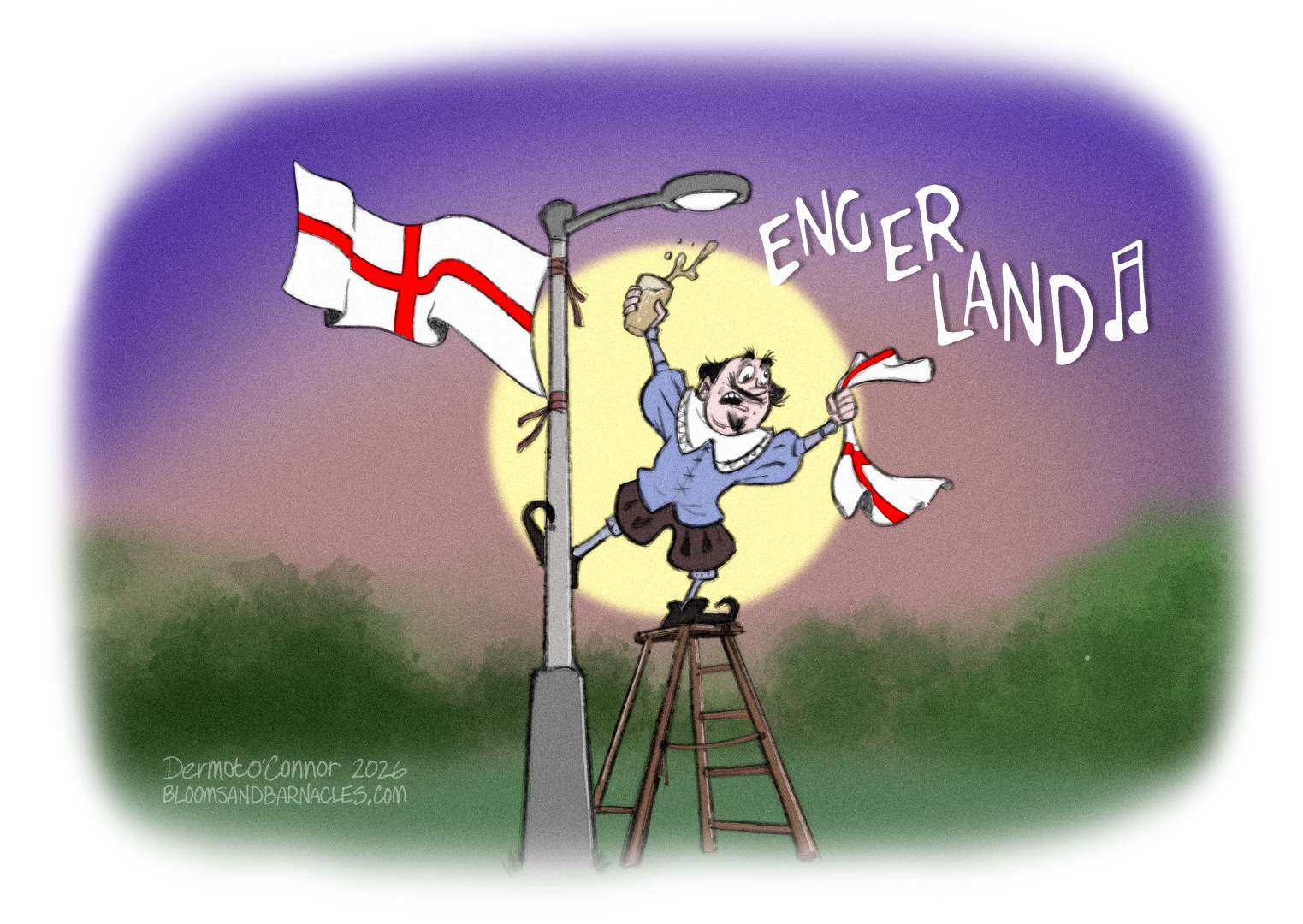
Isn’t Carrotty Bess great?

Topics in this episode include why Stephen compares Shakespeare to Shylock, Shakespeare’s father John Shakespeare and his many business ventures, his legal troubles caused by some of those business ventures, Shakespeare’s corn-hoarding during a famine, the irony of Irish Nationalists being devoted to Shakespeare, Shakespeare’s role in providing propaganda for Britain’s colonial project, Mr. Deasy’s thoughts on Shakespeare, Chettle Falstaff, the time Shakespeare sued a guy over some malt, how The Merchant of Venice stoked Elizabethan antisemitism, plays that Shakespeare wrote to please various monarchs, James I and Macbeth, political propaganda found in Shakespeare’s comedies, and why Stephen’s point-of-view as an Irish person alters his interpretation of Shakespeare.
Support us on Patreon to get episodes early, and to access bonus content and a video version of our podcast.
On the Blog:
Decoding Dedalus: He drew Shylock out of his own long pocket.
Blooms & Barnacles Social Media:
Facebook | BlueSky | Instagram
Subscribe to Blooms & Barnacles:
Apple Podcasts | Spotify | YouTube
Further Reading:
- Adams, R. M. (1962). Surface and symbol: The consistency of James Joyce’s Ulysses. New York: Oxford University Press.
- Booth, C. (2021, May 6). Who was Philip Rogers, the Apothecary in Shakespeare’s Stratford? Shakespeare Birthplace Trust. Retrieved from https://www.shakespeare.org.uk/explore-shakespeare/blogs/who-was-philip-rogers-the-apothecary-in-shakespeares-stratford/
- Budgen, F. (1972). James Joyce and the making of Ulysses, and other writings. London: Oxford University Press. Retrieved from https://search.library.wisc.edu/digital/AMF2PZFZHI2WND8U
- The Editors of Encyclopaedia Britannica (2024, February 22). Henry Chettle. Encyclopedia Britannica. Retrieved from https://www.britannica.com/biography/Henry-Chettle
- Gifford, D., & Seidman, R. J. (1988). Ulysses annotated: Notes for James Joyce’s Ulysses. Berkeley: University of California Press. Retrieved from https://tinyurl.com/vy6j4tk
- Greer, G. (2008). Shakespeare’s Wife. London: Bloomsbury Publishing.
- Jacobs, J. (2021). LOPEZ, RODRIGO – JewishEncyclopedia.com. Jewishencyclopedia.com. Retrieved from https://www.jewishencyclopedia.com/articles/10109-lopez-rodrigo
- NORRIS, M. (2009). The Stakes of Stephen’s Gambit in “Scylla and Charybdis.” Joyce Studies Annual, 1–33. http://www.jstor.org/stable/26288736
- Osteen, M. (1990). The Intertextual Economy in “Scylla and Charybdis.” James Joyce Quarterly, 28(1), 197–208. http://www.jstor.org/stable/25485125
- RASMUSSEN, I. D. (2019). Riffing on Shakespeare: James Joyce, Stephen Dedalus, and the Avant-Garde Theory of Literary Creation. Joyce Studies Annual, 33–73. https://www.jstor.org/stable/26862950
- Schutte, W. (1957). Joyce and Shakespeare; a study in the meaning of Ulysses. New Haven: Yale University Press. Retrieved from https://archive.org/details/joyceshakespeare00schu
- Shakespeare Birthplace Trust. (n.d.). John Shakespeare. Shakespeare Birthplace Trust. Retrieved from https://www.shakespeare.org.uk/explore-shakespeare/shakespedia/william-shakespeare/william-shakespeares-family/john-shakespeare/